



In an industry where every delayed shipment can affect patient care, a supply chain checkup for healthcare is no longer just an operational best practice; it’s a strategic necessity.
Foodservice costs do not always announce themselves with a dramatic price increase. More often, they creep into the budget quietly.
A contract price is entered incorrectly. A credit never appears. One community orders an approved product while another purchases a more expensive alternative. A manufacturer agreement expires without anyone realizing the pricing has changed.
Individually, these issues may not look alarming. Spread across hundreds of products, thousands of invoices, or several locations, they can take a meaningful bite out of a healthcare or senior living organization’s foodservice budget.
That is why supply chain management should be treated as an ongoing financial checkup rather than a one-time negotiation. A strong contract is a good place to start, but protecting the value of that contract requires regular oversight.
Why Strong Supplier Agreements Don’t Always Prevent Cost Leakage
Negotiating favorable supplier agreements is important. It is not, however, the same as confirming that every location is purchasing the right products at the right prices.
Foodservice supply chains have a lot of moving pieces. Prices change, products become unavailable, manufacturers update programs, and individual locations make purchasing decisions based on immediate needs. Without consistent monitoring, the supply chain can slowly drift away from what was originally negotiated.
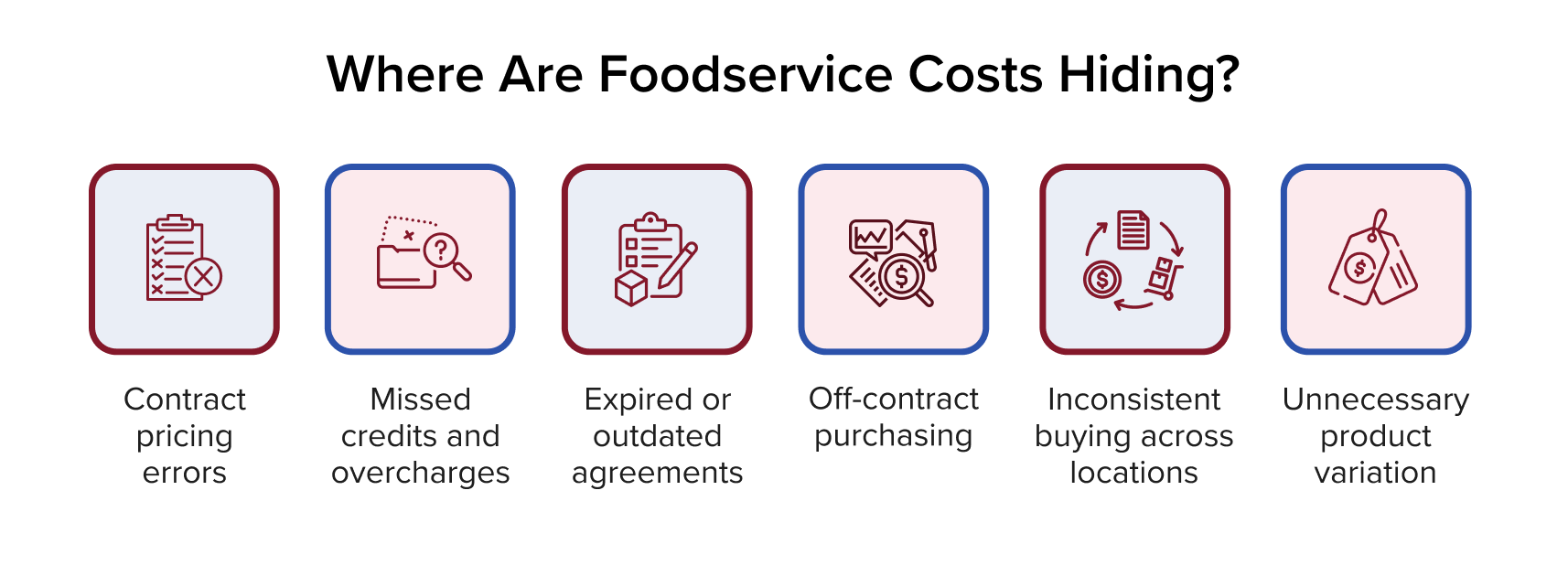
Contract Pricing Errors and Invoice Discrepancies
The price listed in an agreement and the price charged on an invoice should match. In practice, that does not always happen.
A product may be billed at the wrong contract tier. A temporary price change may remain in place longer than expected. A manufacturer allowance may not make its way through the distribution process correctly. Even a simple item-number mismatch can prevent a facility from receiving its negotiated price.
These discrepancies can be difficult to spot when teams are reviewing invoices manually. The amount attached to one case may look small, particularly during a busy week. But if the same error appears on every order, at multiple locations, the total adds up quickly.
Routine price verification gives operators a clearer answer to a basic but important question: Are we paying what we agreed to pay?
Missed Credits and Unresolved Overcharges
Finding an incorrect charge is only the first step. Someone still has to document it, contact the appropriate party, follow its progress, and confirm that the credit was issued.
That follow-up can easily fall to the bottom of the list for a dining director or administrator managing dozens of other responsibilities. The organization may recognize that it was overcharged without ever recovering the money.
A consistent auditing process closes that gap. It identifies discrepancies and keeps them from disappearing into an email thread or an old invoice. When an error is found, it should be tracked until the account receives the credit it is owed.
Outdated Manufacturer and Distribution Agreements
Foodservice needs change over time. Menus are revised, locations open or close, purchasing volumes shift, and new products enter the market. An agreement that worked well two years ago may no longer reflect what the organization buys today.
Allowing contracts to renew without reviewing current purchasing behavior can leave savings on the table. Operators may be negotiating around products they no longer use heavily while overlooking categories where their volume has grown.
Regular contract reviews give healthcare and senior living organizations an opportunity to compare their agreements with actual purchasing activity. They can then determine where pricing needs to be renegotiated, which manufacturer programs should be renewed, and whether current distribution terms still support the operation.
Check Your Purchasing Activity for Hidden Costs
Contract management is only part of the picture. The way individual facilities purchase against those agreements also affects the final cost.
A supply chain checkup for healthcare should look beyond the terms on paper and examine what is actually happening across invoices, order guides, products, and locations.
Off-Contract and Non-Compliant Purchases
An organization may have preferred products and negotiated pricing in place, but that does not automatically mean every facility purchases accordingly.
An approved item could be unavailable when an order is placed. A team member might select a familiar brand instead of the contracted option. A distributor substitution may continue long after the original product returns. In some cases, employees simply may not know which products are covered by an agreement.
These off-contract purchases can weaken the value of negotiated pricing and reduce the volume needed to qualify for certain programs. They also make it harder to understand the organization’s true product costs.
Reviewing purchasing compliance helps operators identify where buying behavior has moved outside the program and why. The answer may call for an order guide update, additional training, a conversation with the distributor, or a better product alternative.
Inconsistent Purchasing Across Locations
Multi-location organizations often discover that no two facilities purchase exactly the same way.
One location may use the contracted chicken product while another buys a comparable item at a higher price. Facilities may order different pack sizes, brands, or specifications for similar menu applications. Those differences may be intentional, but they may also be habits that developed over time.
Purchasing data can help leaders separate necessary local choices from avoidable inconsistencies. It provides a fuller view of what each location buys, what it pays, and where standardization could improve purchasing power.
The goal is not to remove every local decision. It is to make sure those decisions are informed and that differences between facilities have a sound operational reason behind them.
Unnecessary Product and SKU Variation
More choice is not always better for the foodservice budget.
Carrying several similar products can fragment purchasing volume, complicate inventory, and make it harder for employees to follow an approved order guide. A facility may stock multiple versions of an item when one or two would meet the same menu need.
Product rationalization looks for places where the organization can reduce unnecessary variation. Consolidating volume around selected products may strengthen negotiating leverage while making ordering and inventory management more consistent.
Any change must still account for nutrition requirements, resident preferences, allergen considerations, preparation methods, and menu quality. The cheapest product is not automatically the best fit. The better choice is the one that delivers the right balance of price, performance, and experience.
Strengthen Your Foodservice Supply Chain
Once the organization understands where costs may be leaking, the next step is turning that information into action.
That requires more than a spreadsheet of potential issues. Operators need processes for verifying pricing, reviewing agreements, evaluating products, and monitoring the results.
Audit Pricing Against Current Contracts
Pricing audits compare invoiced costs with the terms the organization negotiated.
This process can reveal incorrect prices, missing allowances, unexpected increases, and other discrepancies that may be difficult to catch during a standard invoice review. It also creates a record of recurring problems, making it easier to identify patterns instead of addressing each error in isolation.
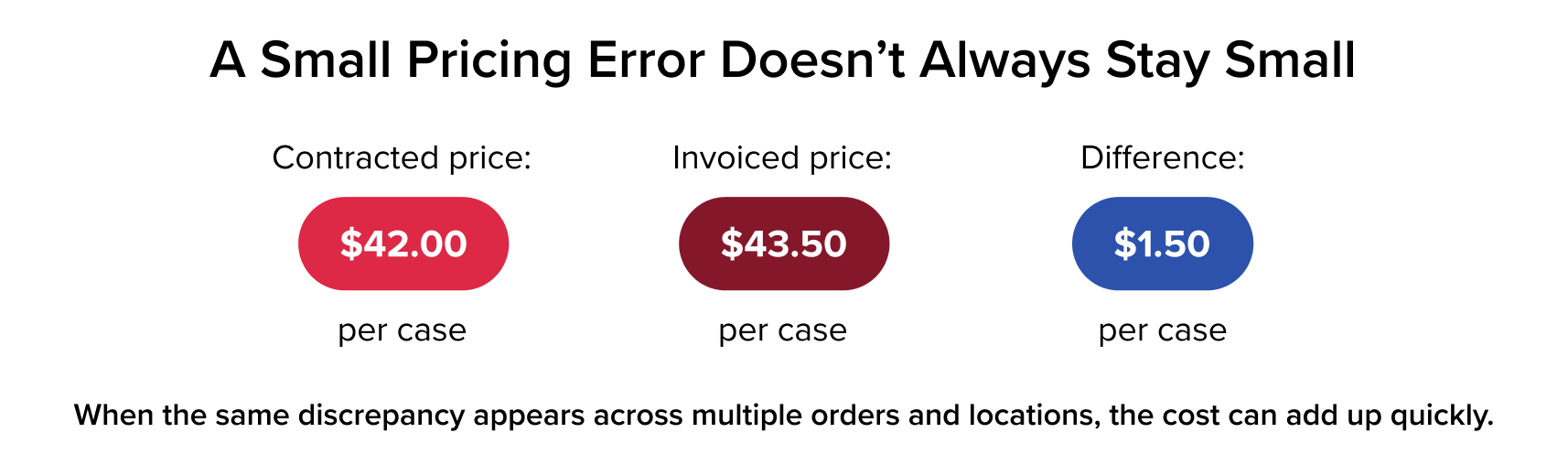
Auditing should not happen only after food costs spike. Regular oversight allows the organization to catch issues earlier and pursue credits before discrepancies become part of the normal budget.
Review Manufacturer and Distributor Agreements
Manufacturer and distribution agreements should be reviewed alongside the organization’s current purchasing data.
Healthcare organizations are already looking for better ways to connect contracting decisions with compliance, risk management, and financial performance. The Association for Health Care Resource & Materials Management explores this need in its guidance on modernizing healthcare contracting.
For foodservice leaders, the review should consider more than the headline price. Are facilities purchasing enough volume to receive the intended value? Do the contracted products still match the menu? Are pricing terms being applied consistently? Have new categories or sourcing opportunities emerged since the agreement was signed?
A contract delivers value only when its terms align with the way the organization currently operates.
Identify Strategic Product Substitutions
Product substitutions are sometimes unavoidable. Supply disruptions, discontinued items, changing menu needs, or new nutritional requirements can all lead an operation to consider an alternative.
The key is to evaluate substitutions strategically rather than accepting whichever product happens to be available.
A suitable alternative should be reviewed for cost, quality, yield, pack size, labor requirements, nutrition, and menu application. A lower case price may not create savings if the product produces less usable yield or requires more preparation. On the other hand, a comparable product may lower costs without changing the resident or patient experience.
Expert product sourcing helps operators compare those tradeoffs and find options that protect both margins and dining standards.
Use Spend Data to Prioritize Savings Opportunities
Purchasing data can tell a much bigger story than the amount spent last month.
When data from multiple facilities, distributors, and product categories is brought together, operators can identify pricing variation, off-contract purchases, high-spend categories, and potential product conversions. They can also see where one location is outperforming another and investigate what is driving the difference.
Not every opportunity deserves equal attention. Spend intelligence helps teams focus first on the changes that could have the greatest financial impact.
That might mean correcting a widely purchased item with inaccurate pricing, consolidating volume in a major category, or reviewing an agreement that covers several locations. The data points the team toward the places where its time can produce the strongest return.
Balance Cost Control With Quality and Continuity of Care
Healthcare and senior living foodservice cannot be managed on cost alone.
Every purchasing decision has operational consequences. Products must meet nutritional requirements, arrive when needed, perform consistently in the kitchen, and support an experience that patients or residents can enjoy.
Protect Resident and Patient Dining Standards
Food plays an important role in daily life within a healthcare or senior living community. For residents, mealtimes provide familiarity, comfort, and an opportunity to connect with others. For patients, nutrition supports their care and recovery.
Cost-saving decisions should respect that role.
A product change that looks promising financially may not work if it affects taste, texture, portion consistency, or therapeutic menu requirements. Procurement teams and dining leaders need to evaluate savings opportunities together so financial improvements do not create problems elsewhere.
Maintain Reliable Product Availability
A good price has limited value if the product is frequently unavailable.
Reliable sourcing helps foodservice teams maintain menu consistency and avoid expensive last-minute purchases. It also gives operators more time to evaluate alternatives when shortages occur instead of making decisions under pressure.
Supply chain management should include ongoing communication with manufacturers and distributors, visibility into potential disruptions, and a clear process for approving substitutions. That preparation can help facilities respond more effectively when an item becomes difficult to source.
Support Each Location’s Operational Needs
Standardization can strengthen contracts and simplify purchasing, but healthcare and senior living locations are not interchangeable.
A rehabilitation facility, hospital, and senior living community may serve different populations and follow different menu cycles. Even locations within the same organization can have distinct service models, equipment limitations, or resident preferences.
The best supply chain strategy creates consistency where it makes sense while leaving room for genuine operational needs. Data and procurement expertise can help leaders tell the difference between a necessary exception and an expensive habit.
Make Supply Chain Management an Ongoing Practice
A supply chain checkup for healthcare should not be a once-a-year exercise.
Food prices, purchasing patterns, product availability, and organizational needs continue to change. Regular monitoring helps operators protect negotiated savings and respond before a small issue becomes a costly one.
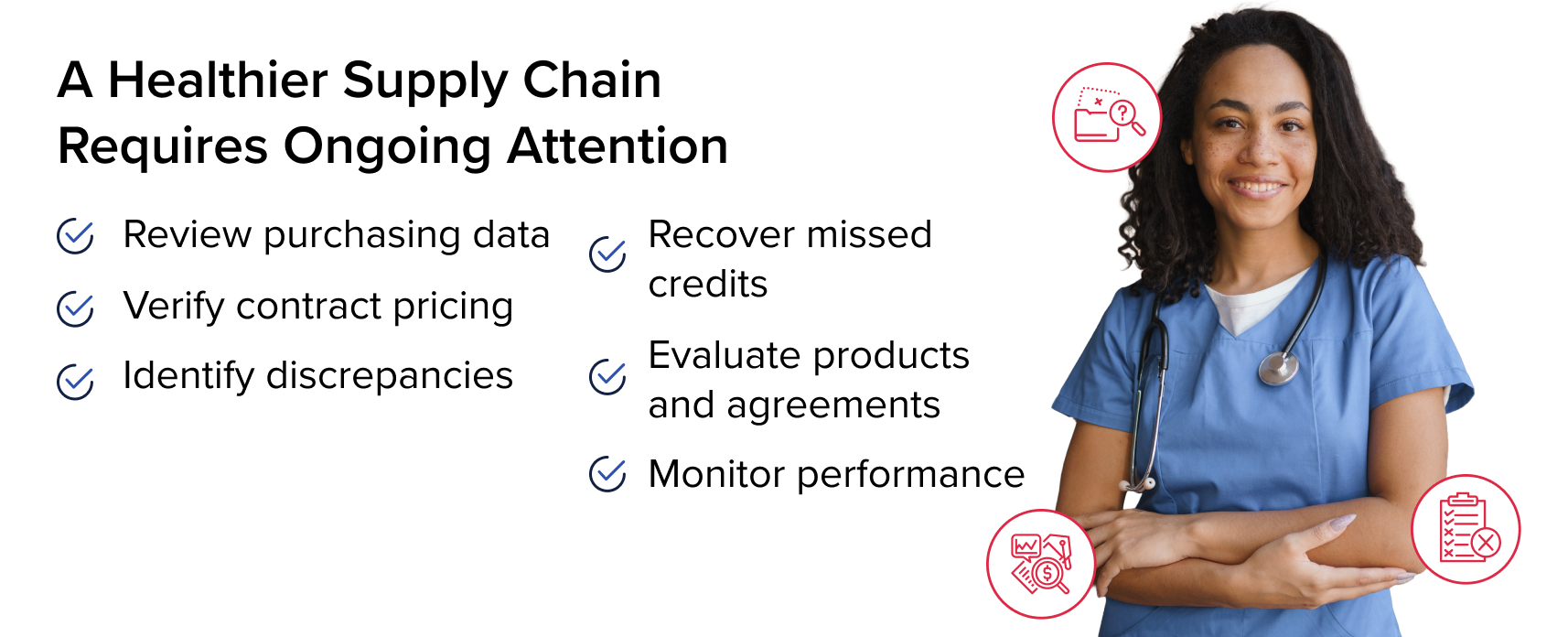
Monitor Pricing and Purchasing Performance
A recurring review of pricing, contract compliance, category spend, and location-level activity gives leaders a clearer view of supply chain performance.
The right cadence may vary by organization. High-volume categories or volatile products may need closer attention, while more stable areas can be reviewed less frequently. What matters is having a defined process rather than waiting for a budget variance to signal that something went wrong.
Pursue Credits When Discrepancies Are Found
Every pricing discrepancy needs a clear owner and a path to resolution.
That process should include documenting the agreed-upon price, validating the invoice, submitting the claim, and confirming that the credit appears. Without the final step, an identified overcharge is still an unrecovered cost.
This is one of the areas where outside supply chain support can make an immediate difference. A procurement partner can handle the follow-up and chase down credits while internal teams stay focused on the operation.
Reevaluate Contracts and Products as Needs Change
Contracts, approved products, and order guides should evolve with the organization.
Changes in census, menus, service models, distributor coverage, and facility count can all affect what represents the best value. Scheduled reviews give leaders an opportunity to update the purchasing program before outdated decisions become embedded in daily ordering.
A healthy supply chain is not static. It adjusts while maintaining the controls needed to protect pricing and purchasing consistency.
Find More Savings With Prime Services
Savings may already be hiding inside your current foodservice purchases. Finding them requires the right combination of contract expertise, purchasing visibility, and follow-through.
Prime Services provides customized supply chain solutions for healthcare and senior living operators by leveraging the contracts, data, technology, and billions in buying power available through Buyers Edge Platform.
Our procurement teams work alongside a dedicated Client Manager to help manage every element of the supply chain. That includes negotiating distribution contracts, securing and renewing direct manufacturer pricing, sourcing products that support stronger margins, auditing invoices against agreements, and pursuing credits when discrepancies are found.
We also work alongside distributor partners to help operators maximize savings without disrupting the relationships and processes that keep their facilities running.
With secure and accurate pricing, spend intelligence technology, invoice and contract auditing, and hands-on procurement support, operators gain more than a list of possible savings. They gain a team dedicated to turning those opportunities into results.
Your organization calls the shots. Prime Services brings the data, technology, contracts, and supply chain expertise to help you see where your money is going—and where more of it can be saved.