

An extra delivery fee here. A missed rebate there. A storeroom full of supplies that someone ordered because they couldn’t tell what was already on hand. None of these issues looks especially serious on its own. Across departments and locations, though, they can quietly stretch a facility’s budget.
For senior living communities, assisted living operators, and skilled nursing facilities, healthcare procurement is about more than getting a lower price. It means having the right products available, keeping purchasing manageable for busy teams, and protecting the quality residents depend on. Here are five common mistakes worth looking for—and practical ways to avoid them.
Why Effective Healthcare Procurement Matters
How Everyday Purchasing Decisions Impact Facility Budgets
Foodservice, housekeeping, maintenance, and care teams all make purchasing decisions. When each department orders independently, the total cost can be difficult to see. One location might pay more for an item another location buys under contract. A small order might trigger a delivery charge that a coordinated order would have avoided.
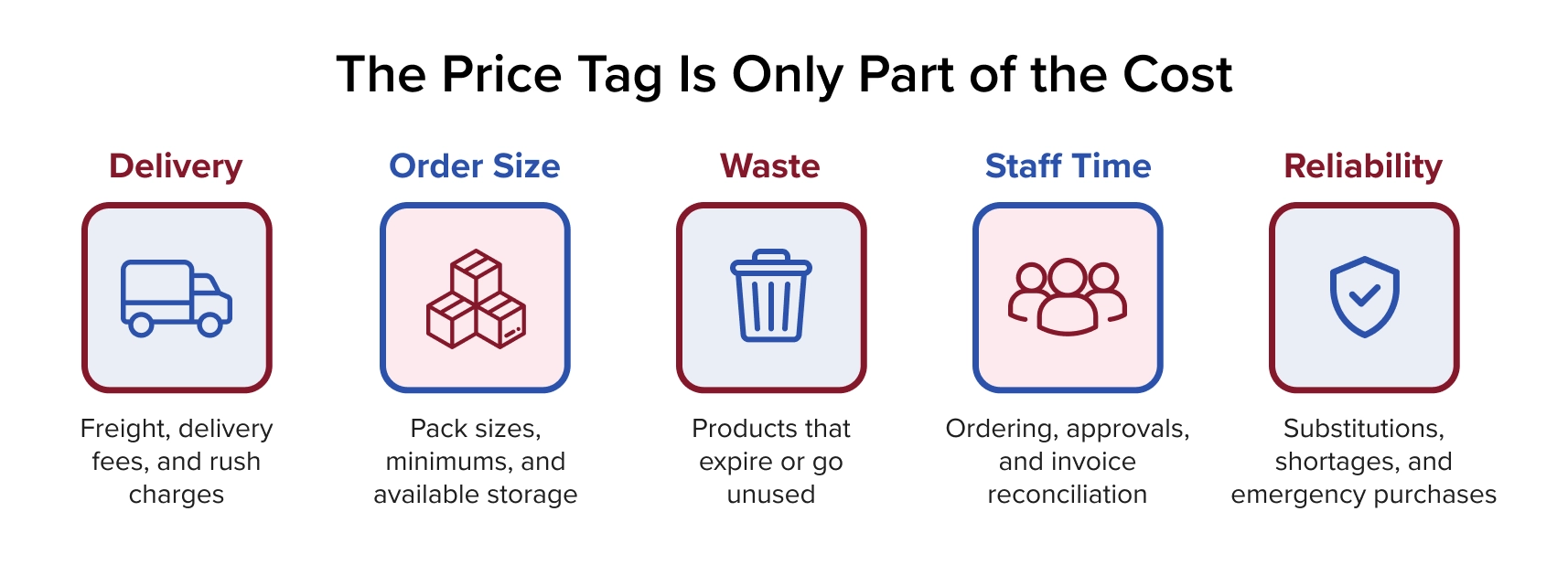
Effective healthcare purchasing looks beyond the invoice price. Order frequency, freight, pack size, storage capacity, waste, and staff time all matter. A lower-priced case is not necessarily a better buy if half its contents expire before the team can use them.
The Connection Between Procurement Efficiency and Quality Resident Care
Purchasing decisions reach residents in everyday ways: whether a preferred menu item is available, whether housekeeping has the supplies it needs, and whether staff have to interrupt their work to find a replacement product.
The goal is not to buy the cheapest option at every opportunity. It is to reduce avoidable spending while maintaining appropriate quality, safety, and service. Before changing a product, involve the people who use it and confirm that it meets resident needs and facility requirements.
Mistake #1: Not Tracking Purchasing Data
Why Limited Spending Visibility Can Lead to Unnecessary Costs
Invoices may live in one system, order histories in another, and department purchases in someone’s email. Without a clear view of spending, it is hard to know whether prices are consistent or whether the facility is buying more than it needs.
For a multi-location operator, the gaps can be larger. Two communities may buy the same item from the same supplier at different prices, and neither team would know to question it. Looking only at total monthly spending can hide those differences.
How to Use Purchasing Data to Identify Savings Opportunities
Start with a manageable set of information: supplier, product, quantity, pack size, unit price, department, and location. Bring together several months of purchasing records, then look for price differences, duplicate products, unusual order patterns, and purchases outside approved contracts.
Compare equivalent units before drawing conclusions. A case of six containers is not directly comparable with a case of twelve. Once the data is consistent, choose one category to review with the department that uses it. You do not need a perfect dashboard to start asking better questions.
Mistake #2: Overlooking Contract Pricing and Available Rebates
How Facilities Miss Out on Potential Purchasing Savings
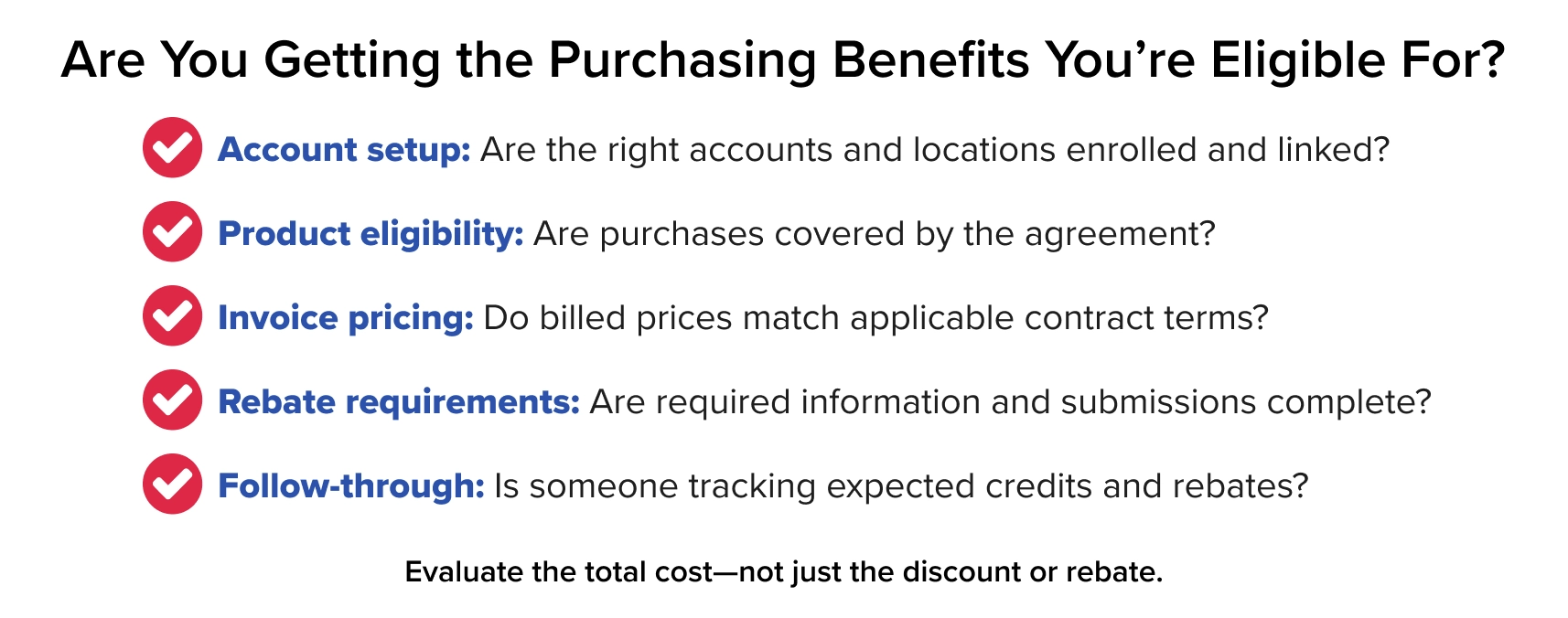
Access to a purchasing agreement does not automatically mean every eligible order receives its benefits. A facility may have an account that is not linked correctly, buy a noncontract item when an appropriate contracted alternative exists, or miss an eligible rebate because required information was not submitted.
These issues can be easy to overlook when teams are focused on getting an order placed. The savings may be available, but someone still needs to verify eligibility, enrollment, pricing, and any program requirements. Rebates also need to be considered separately from upfront discounts; they are not always paid at the time of purchase.
Why Regularly Reviewing Supplier Agreements Matters
Build a recurring review of supplier agreements and purchasing programs into your schedule. Check effective dates, covered products, applicable locations, rebate terms, and any purchasing commitments. Compare a sample of invoices with the pricing your facility should receive, and ask your supplier or program representative to explain discrepancies.
Assign someone to track required submissions and follow up on expected credits or rebates. Evaluate the total cost, too: a rebate does not make an unsuitable product or an unfavorable overall price a good purchasing decision.
Mistake #3: Using Too Many Vendors Without a Clear Purchasing Strategy
How Fragmented Purchasing Creates Inefficiencies
Having several vendors is not automatically a problem. Having no clear reason for using them can be. If departments routinely open new accounts for small purchases, the facility can end up managing more invoices, delivery schedules, minimum orders, and pricing arrangements than necessary.
Fragmented spending also makes it harder to understand the facility’s overall purchasing position. Staff may spend time comparing nearly identical items across multiple catalogs while missing opportunities to coordinate orders. What feels convenient for one purchase can create extra work across the operation.
When Vendor Consolidation Makes Sense
Review suppliers by category and purpose. Which provide reliable service, appropriate products, competitive total costs, or a specialty you cannot easily replace? Where do vendors overlap without adding meaningful value?
Consolidation can make sense when a preferred supplier can meet your requirements and simplify ordering. It should not leave the facility dependent on a single source for critical supplies, however. Keep qualified backup options and account for delivery coverage, emergency support, and location-specific needs. A clear purchasing strategy defines when to use a preferred supplier and when an exception is justified.
Mistake #4: Relying on Manual and Outdated Purchasing Processes
How Manual Ordering Can Increase Errors and Administrative Work
A handwritten request becomes an email. The email becomes an order. Later, someone reenters the details to reconcile the invoice. Each handoff creates another opportunity for a wrong quantity, duplicate purchase, missed approval, or coding error.
Manual work also makes it difficult for teams to answer simple questions: Has this been ordered? Who approved it? Did the delivery arrive? When the answers depend on finding the right person, purchasing can slow down whenever that person is unavailable.
The Benefits of Digital Procurement Technology
Digital procurement tools can centralize order information and, depending on the system, support approved catalogs, purchasing permissions, approval workflows, and reporting. Instead of searching through inboxes, teams can work from a more consistent record of purchasing activity.
Start by identifying the problem you need technology to solve. A community struggling with duplicate orders may need better order visibility; a multi-location operator may need consistent reporting. Confirm how a solution handles your suppliers and existing systems, then train the people who will use it. Technology is most useful when the process behind it is clear.
Mistake #5: Taking a Reactive Approach to Supply Chain Management
How Last-Minute Purchasing Can Drive Up Costs
An unexpected shortage can force a facility to pay expedited freight, accept a higher-priced substitute, or send an employee to buy supplies locally. Sometimes an urgent purchase is unavoidable. When it happens repeatedly, it is worth looking beyond the immediate shortage.
The cause may be an inaccurate inventory count, an overlooked delivery lead time, or an ordering routine that no longer matches demand. Occupancy changes, seasonal menus, special events, and changes in resident needs can all affect what the facility uses.
Why Proactive Planning and Supplier Relationships Matter
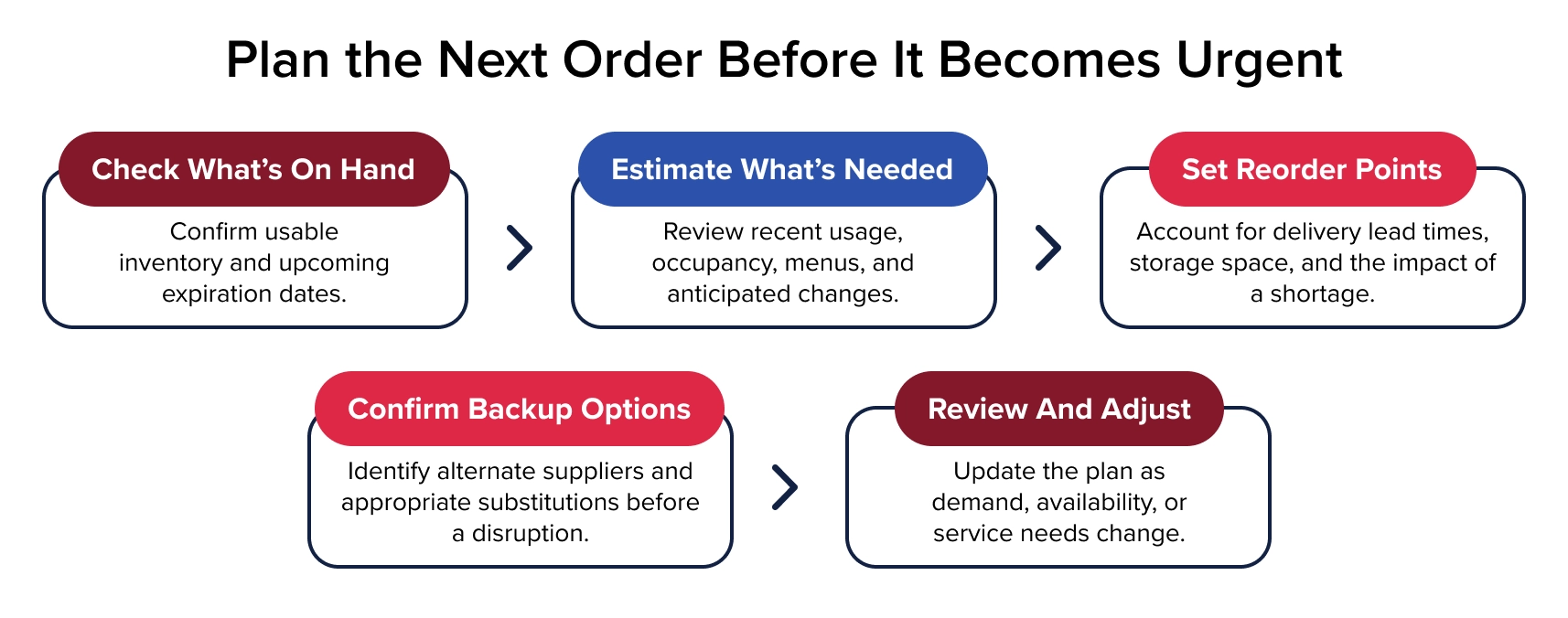
Use recent consumption and expected demand to set practical reorder points for essential items. Account for delivery lead times, storage space, expiration dates, and the consequences of running out. Review those assumptions when occupancy or service needs change rather than relying on the same order indefinitely.
Keep an open line of communication with suppliers about availability, delivery changes, and acceptable substitutions. Agree internally on which alternatives staff can approve and which require a clinical, dietary, or operational review. Good healthcare supply chain management includes a backup plan before the usual product becomes unavailable.
How Healthcare Facilities Can Build a Smarter Procurement Strategy
Establish Consistent Purchasing Practices
Write down who can order, which suppliers and products are preferred, when approval is required, and how exceptions should be handled. Keep the guidance short enough that staff will actually use it.
For multi-location organizations, standardize what makes sense without ignoring local requirements. Consistent processes should make work easier, not prevent a community from meeting a resident’s specific needs.
Regularly Evaluate Spending and Supplier Performance
Set a regular review with purchasing, finance, and department leaders. Track a small group of useful measures, such as spending by category, use of contracted products, invoice pricing discrepancies, emergency orders, and delivery reliability.
Look for explanations, not just variances. Higher food spending may reflect increased occupancy rather than poor purchasing. A cheaper supplier may generate more substitutions or missed deliveries. The best healthcare procurement practices consider cost and service together.
Leverage Technology and Purchasing Programs to Improve Efficiency
Use purchasing data to decide where support would have the greatest impact. That might mean improving reporting, checking contract alignment, exploring available group purchasing organization (GPO) programs, or getting help with a difficult supply category.
Before adding a solution, ask what it will change for your team. Who will review the findings? Who will resolve pricing issues? How will you measure progress? Clear ownership turns insights into action and helps prevent the same healthcare procurement challenges from returning.
Make Healthcare Procurement Easier With Prime Services
These five mistakes have something in common: they are harder to address when purchasing information, supplier relationships, and daily processes are disconnected. A more strategic approach brings them together, giving your team a clearer view of what you buy and where improvements may be possible.
At Prime Services, we help non-acute healthcare facilities do more with their purchasing. As a Buyers Edge Platform brand, we connect operators with purchasing programs, data and analytics, technology services, and supply chain expertise. Our approach is built around your facility’s needs, not a one-size-fits-all purchasing model.
Whether your priority is purchasing visibility, access to negotiated contracts and eligible rebates, or a more manageable supply chain, we help you identify a starting point. Our AI-enabled purchase-data analysis matches purchasing activity against available contracts and rebate opportunities. Our dedicated client management team then works with you to understand the findings and pursue applicable savings.
You do not have to tackle every purchasing challenge at once. Start with the area creating the most friction, and build from there—with support that helps your team spend less time sorting through procurement and more time focusing on residents.
Click here to contact Prime Services and learn how we can help your facility simplify procurement and uncover new savings opportunities.